

eelmigrationThe report – Understanding downstream migration timing of European eel (Anguilla anguilla) – is finally available to DOWNLOAD.

Summary: The European eel stock has long been in decline. Consequently, the species has been added to the IUCN Red List of Threatened Species. One threat that has been identified as one possibly having an impact on the stock is mortality caused by hydroelectric power plant turbines. Turbine management, which is adapted to preferable migration conditions, might reduce the risk of this threat. Our study, conducted at five locations in southern Sweden, aimed at learning about the migratory behaviour of European silver eels paying special attention to preferable environmental conditions for migration by using advanced statistical modelling.

Results indicated that downstream migration triggers can be reliably described using hydrological variables (discharge, precipitation or one of their dynamic derivations), water temperature and moon. Spring and autumn migrations seemed to be triggered differently. In spring, rising water temperatures seemed to be the key trigger, quite independently of hydrological variables and the moon. In the autumn, the importance of the moon and hydrological variables on downstream migration increased. In addition, migration triggers differed depending upon the size of the body of water and/or its location in the river system. In smaller/upstream tributaries, hydrological variables seemed to be the key trigger. In larger/downstream waters, the importance of water temperature and the moon increased.

The transferability of models was limited. Moreover, models indicated that in some cases, the dynamics of water temperature and hydrological variables (precipitation, discharge) provided more explanatory power than the measured, absolute values. Transferability among time series from the same location delivered some reliable results. Success of transferability between locations was limited to sites which originated from the same river catchment. In spring, migration activity did not occur until water temperatures exceeded 6.5 °C in a tributary and 9 °C in the Kävlingeån River. Eels showed significant nocturnal migration behaviour (98.5 %; n = 205) and migration activity became very unlikely in autumn if water temperatures dropped below 5 °C.

Our data on spring migration is limited to one site in a tributary and one site in a lower mainstream. Furthermore, spatial transferability among catchments has not been tested in previous studies. Therefore, we recommend that future studies be performed during the spring and autumn migrations in tributaries as well as lower mainstreams.

Moreover, previous studies indicate that some eels hesitate for several days or even reverse upstream instead of entering the traps the same night that they arrive. Additional visual techniques such as hydroacoustic cameras should be applied upstream of catch facilities in order monitor eel migration activity of unharmed eels. This enables the validation of trap catchability and consequently the response of our models.

Our results clearly show that turbine induced mortality could be minimized if turbine operation focuses on daytime periods, when water temperature is below 5 ° C and when the discharge not is stable or decreasing. Moreover, local adaptive turbine management should be accompanied by studies to determine the local constellation of environmental triggers. In addition, it will be crucial, that later applications (e.g. turbine management, early warning systems etc.) consider the temporal dynamic of water temperature and hydrological variables.
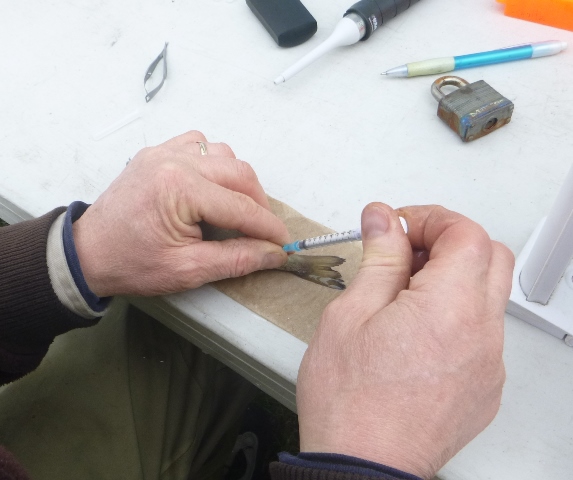
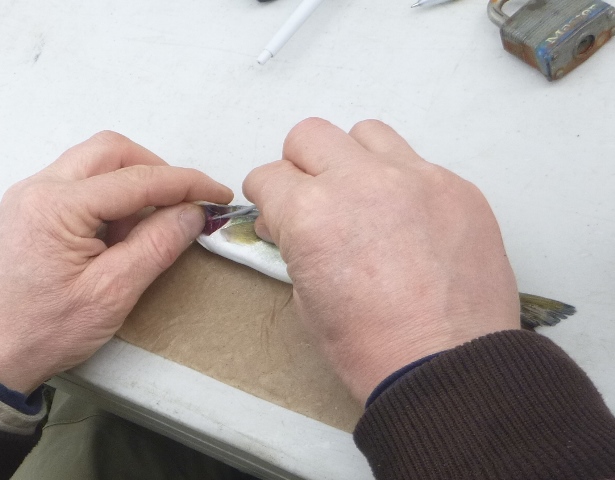
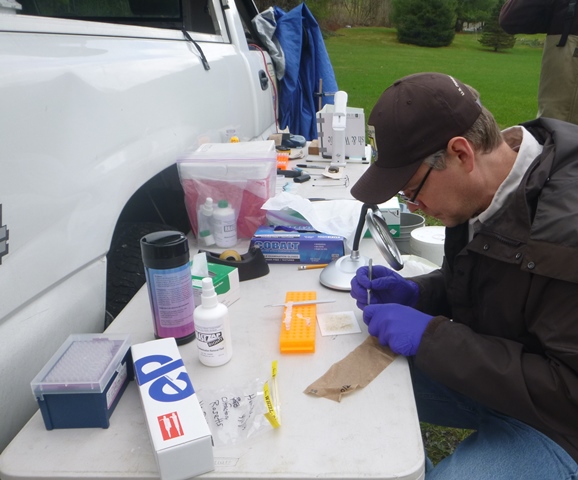
Just nu analyserar jag telemetri-data från studien av smoltvandringen i Huntington-Winooski River i Vermont, USA som genomfördes i våras. Parallelt med migrationsstudien undersökte US Fish and Wildlife Service, tillsammans med Stephen McCormick, smolt-fysiologi och dess samband med fiskens uppväxtmiljö (odlingsmiljö) och vandringsbenägenhet. Blodprov och gälprov togs för att undersöka hormonhalter och nivåer av Na+/K+-ATPase (ett enzym som är viktig för fiskens saltregleringen, och ofta använt som ett mått på smoltifieringsgrad). De tog även prover av olfactory rosettes, som kan ha en viktig roll i fiskens imrpinting (möjlighet att hitta tillbaka till samma flod). De ämnar undersöka vilka gener som transkriberas i relation till tiden för smolt-vandringen, smoltifieringsgrad och odlingsmiljö. Vi ser fram emot resultaten.

Physio1

Blodprovtagning

Physio2

Gälprovtagning

Physio3

William Ardren, US Fish and Wildlife Service, provtar olfactory rosettes i fält.


Seminarium: Partial Migration

Posted by Daniel Nyqvist | Events

Imorgon, tisdagen den 11 November, klockan 13:15 kommer Anders Nilsson, professor vid Karlstads Universitet, att hålla ett seminarium med titeln: “Almost there and back again: causes and consequences of fish partial migration”. Alla är välkomna!

Observera att seminariet ges i rum 21E415. Alltså inte i den sedvanliga seminarie-salen.

Filmtips: Stör på SVT-play

Posted by Daniel Nyqvist | Nyheter

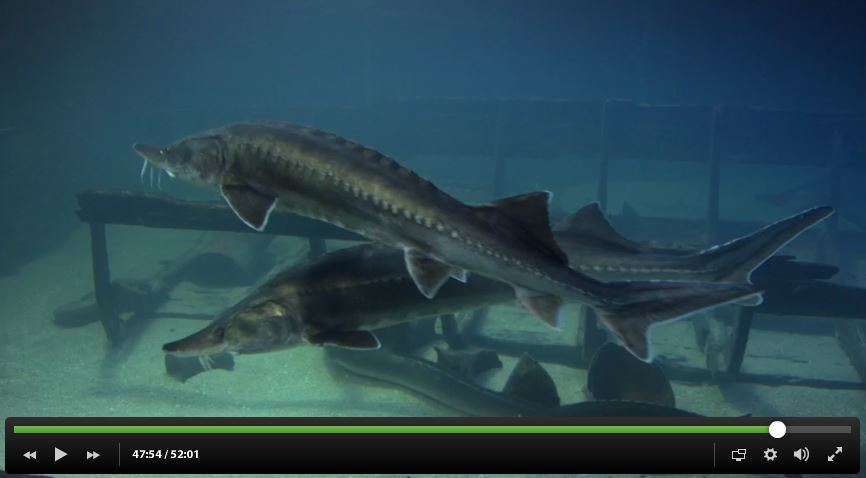
“Världens dyraste fisk” är en dokumentärfilm om stören i Donau. Forskare, fiskare och förvaltare intervjuas om den hotade fisken. Fisken är hotad av habitatförstörelse, överfiske och vandringshinder. Allt färre individer finns kvar. Bevarande-arbetet som beskrivs handlar om kompensationsodling, habitatskydd och fiskereglering. Filmen kan just nu ses på SVT-Play.

stör

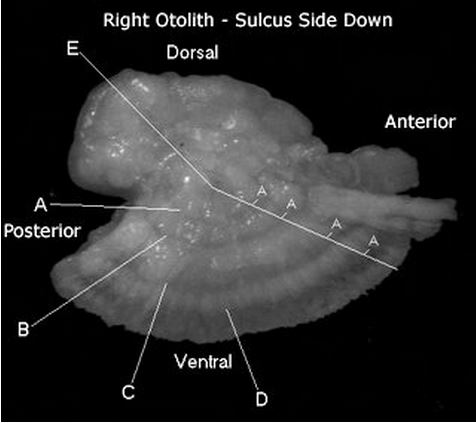
På måndag, den 10 november kl 13.15 i rum 5C421A, kommer Magda Andersson att redovisa sitt masters-arbete: “Utvärdering av rörelsemönster hos öring (Salmo trutta) utifrån otolitmikrokemi”.

Alla är välkomna!

Oscar Askling, masterstudent at Karlstad University, reports on the latest progress in Daugava River:

Daugava River is the biggest river in Latvia. It originates at the Valdaja plateau and flows 1020 km through Russia, Belarus and Latvia and empties in to the Gulf of Riga in the Baltic Sea. During the hydropower cascades, from 1938 to 1974; Kegums, Plavinas and Riga Hes were built, which are today producing a great proportion of the total energy production in Latvia. However, the dams affect the longitudinal connectivity, restricting fish migrations. Reductions in fish populations have been reported since the cascade was completed, including the extinction of the sturgeon (Acipenser oxyrinchus) and the blue bream (Ballerus ballerus). In addition, natural reproduction of Atlantic salmon (Salmo salar) does no longer exist, according to the current knowledge. It is impossible for the salmon to pass the first hydropower station Riga Hes near the Daugava river mouth, to reach the historical spawning areas upstream Plavinas Hep. Consequently, fish-stocking was implemented to maintain the fish populations. The hatchery-reared smolts are released downstream Riga Hes, but since they are not tagged it is not possible to differ between farmed and wild fish.

There are still potential spawning areas for Atlantic salmon in the tributary River Ogre, merging with Duagava between Riga Hep and Kegums Hep. The purpose of this study is to see how Atlantic salmon spawners behave when transported upstream past Riga Hep and released in the River Ogre.  In theory some of them could explore and spawn in Ogre River. Others may become ”fallbacks”. 
17 salmons were tagged subcutaneously with radio transmitters and released upstream a small private-owned hydropower station in Ogre River. The fish were monitored after release using two logger stations (one by River Ogre in a bend upstream Ogre hep, and one at Riga Hep in Daugava) and additional manual tracking.  Unfortunately heavy rains caused severe flooding in River Ogre and consequently all spill gates were opened at Ogre dam. The water was very turbid and coloured. From the automatic logger stations we could see that some tagged salmon immediately swam to Riga Hep. During manual tracking we could see that some were stuck in the intake channel of the Ogre Hep, or migrated slowly downstream, eventually reaching Daugava. Some individuals even went upstream Daugava after their visit at Riga Hep, swimming in the turbine outlets of Kegums Hep. The majority of the tagged salmon passed through the Riga Hep turbines to continue downstream.

At this moment we are preparing to tag another group of fish, which hopefully will be released under more ”normal” circumstances. Assuming that the spill gates at Ogre Hep will remain closed, the new fish will not be able to swim downstream past the Ogre Hep and instead they will have no choice but to remain in the Ogre River, and hopefully migrate upstream towards the spawning areas.

For me personally it has been a great adventure being in Latvia, and I’m learning a lot. The people are really nice and helpful in many ways. It is a nice stay!

Ogre

Best Regards / Oscar Askling

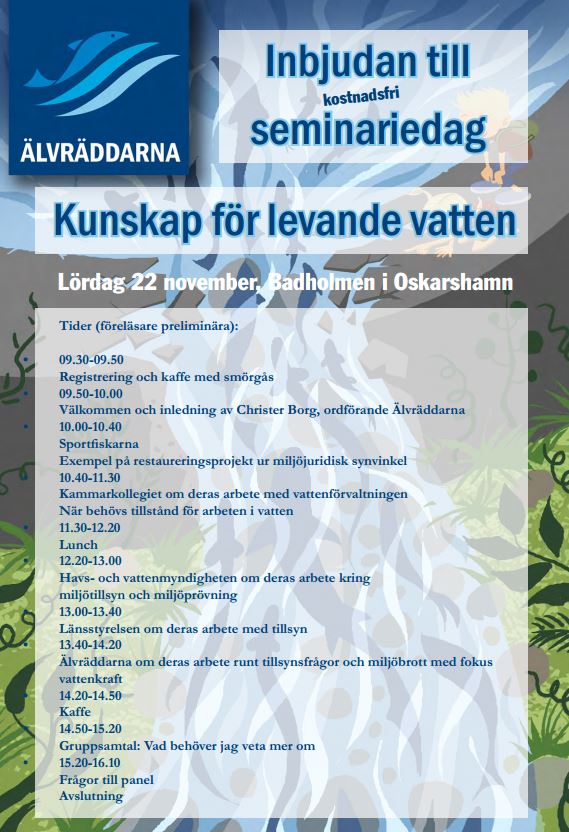
Älvräddarna bjuder in till seminariedagen Kunskap för levande vatten. Seminariet ges lördagen den 22 november på Badholmen i Oskarshamn.

Frågor som väntas tas upp:

• Vilka restaureringsåtgärder i strömmande vatten får jag göra utan anmälan?
• Bedriver ”mitt” lokala vattenkraftverk sin verksamhet enligt gällande villkor?
• Om jag misstänker villkors- eller miljöbrott, hur gör jag då?
• Hur skriver jag en anmälan till länsstyrelse eller polis?

Seminariet riktar sig till alla som engagerar sig i strömmande vatten. Fiskevårdsområdesföreningar, fiskeklubbar, vattenråd, Naturskyddsföreningskretsar och lokala Älvräddargrupper är speciellt inbjudna. Seminariet är gratis och kaffe och lunch ingår.

Sista anmälningsdag är 2014-11-14.

Läs mer på Seminarium: Kunskap för levande vatten.

Älvräddarseminarium

Filmtips: Fria Vatten

Posted by Daniel Nyqvist | Projekt Herting

En film om fiskvandring och passage i Ätran. Fokus ligger på Herting, det nedersta kraftverket. I början beskrivs hur fiskvandringen förbi kraftverket gick till tidigare och sedan avslutas filmen med de nyinstallerade upp- och nedströmslösningarna. Filmen är gjord av produktionsbolaget Caliber.

Canadian RiversThe Mactaquac Aquatic Ecosystem Study (MAES) team will organize a Fish Passage Expert Workshop Nov 3 – 4, 2014 that will be available to the wider community in webinar format.

Register at https://attendee.gotowebinar.com/register/4773654338826738434

WORKSHOP AGENDA (Atlantic Standard Time)

Mon, Nov 3, 2014
08.30-08.40 – Welcome – Tommi Linnansaari; Canadian Rivers Institute (CRI)
08.40-09.20 – Intro to NB Power Mactaquac Project  – George Porter; Mactaquac Project Manager, NB Power
09.20-09.45 – Intro to Mactaquac Aquatic Ecosystem Study (MAES) and Saint John River – Allen Curry; MAES Principal Investigator, CRI
09.45-10.15 – Intro to fishes and hydropower operations of Saint John River – Tommi Linnansaari; CRI

10.20-12.00 – Site visit to the Mactaquac Generating Station
12.45-13.30 – Expert Presentation 1 : Fishway science relevant to fish assemblages- Steven Cooke; Carleton University (Can)
13.30-14.15 – Expert Pres’n 2 : Fish passage: challenges, failures, and potential solutions – Paul Kemp; University of Southampton (UK)
14.15-15.00 – Expert Pres’n 3 : Approach of fish migration and fish passages in Neotropical regulated rivers: the case of Upper Paraná River, Brazil – Sergio Makrakis; Western Parana University (Brazil)

15.30-16.15 – Expert Pres’n 4 : Nature-like fishways around the world: What we are learning – Laura Wildman; Princeton Hydro (USA)
16.15-17.00 – Expert Pres’n 5 :Turbine technologies and turbine survival – Greg Allen; Alden Research Laboratory (USA)
17.00-17.15 – Wrap-up: Day 1

Tues, Nov 4, 2014
8.25-8.30 – Re-cap of Day 1 – Tommi Linnansaari; CRI
8.30-9.15 – Expert Pres’n 6 : Introduction to Upstream Fish Passage Systems – Ed Meyer; National Marine Fisheries Service – West Coast Region (USA)
9.15-10.00 – Expert Pres’n 7 : Discussion of Downstream Passage Systems at Columbia River Dams – John Williams; School of Aquatic & Fishery Sciences, University of Washington (USA)

10.15-11.00 – Expert Pres’n 8 : MAES – Fish passage considerations at Mactaquac Dam and the Saint John – Chris Katopodis; Katopodis Ecohydraulics Ltd. (Can)
11.00-11.45 – Expert Pres’n 9 : Removal or Rebuild? Considerations for the MAES from a river continuity perspective – Alex Haro; USGS, Conte Lab (USA)

Full agenada in pdf-format available here: Fish Passage Expert Workshop 2014.

Fish Passage 2015

Posted by Daniel Nyqvist | Konferens

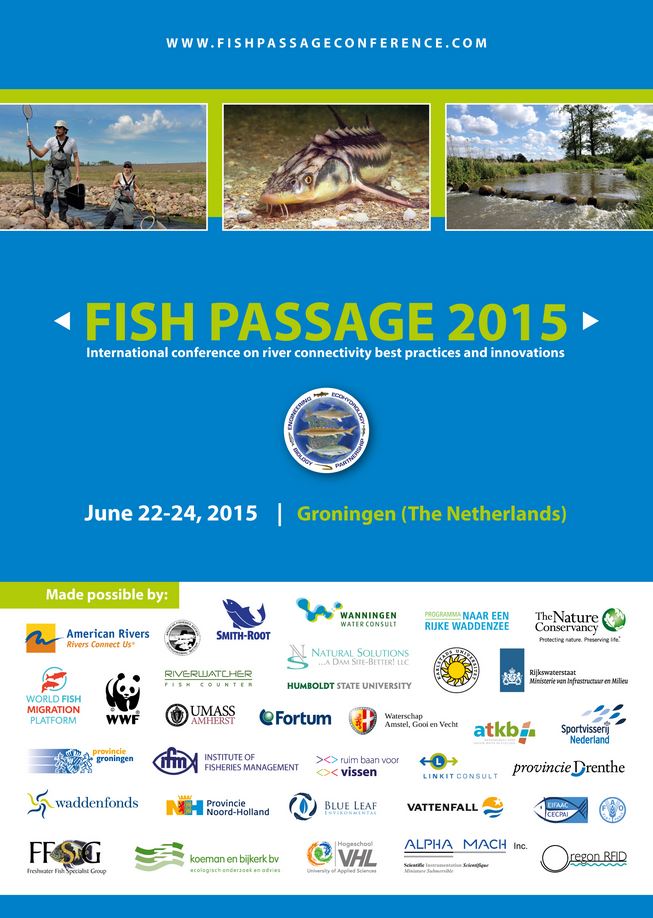
Förberedelserna för Fish Passage 2015 går framåt. Alla tänkbara aspaketer av fiskpassage kommer att behandlas under konferensens 3 dagar, den 22-25 Juni nästa sommar. Konferensen är nu öppen för registrering och det går också att anmäla sig till följande kurser:

  • Dam Removal
  • Fish protection for downstream passage
  • Fishway Evaluation coordinated.
  • Technical and Nature-Like fishways design

Läser mer på http://fishpassage.umass.edu/ eller klicka på affischen nedan:

FishPassage2015