

Salmonid (Atlantic salmon) eggs (photoscienceimage)

Larry Greenberg is currently working on a research project on potential effects of increased winter temperature on brown trout growth and behavior. The research is funded by Karlstad University’s Lecturers and Professors Research Award. Larry describes the project:

“The predicted climate change over the next 65 years will have a major impact on the Earth’s plants and animals. Climate scenarios for Sweden predict that mean annual temperature will increase by 3-5 ° C, with a greater increase in winter than in summer. Because incubation of eggs laid by brown trout and related fishes occurs during winter, the predicted increased winter temperatures may have a major impact on egg development, with far-reaching consequences for fish after they have hatched. The fact that environmental conditions during the egg stage can affect later life stages (juveniles and adults) may seem unlikely, but recent studies have already shown that temperature conditions during egg development can affect growth of juveniles and even reproductive output of adults. As embryonic temperature conditions have been shown to affect growth, one would also expect such conditions to even affect behavior, as behavior and growth are often linked.

For this project, I plan to investigate how an increase in winter temperature conditions during egg development affects the behavior and growth of juvenile brown trout. I will raise fertilized brown trout eggs over the winter at ambient temperature and at 5° C warmer water, and test for subsequent effects on the feeding behavior and personality of juveniles as well as on their growth and metabolic rates.  The research is novel by being the first to investigate whether or not thermal conditions during egg development can affect both the behavior and growth of juveniles.”

The eggs are presently developing under different temperature regimes at Gammelkroppa fish hatchery.
Igår höll Larry Greenberg, professor vid Karlstads Universitet, en presentation om våra forskningsprojekt i Klarälven på ett möte arrangerat av Klarälvens Vattenråd i samverkan med Fortum och Karlstads Universitet. Fokus i presentation låg på förbättrad nedströmspassage för vild laxfisk i Klarälven. Larry rapporterar om ett välbesökt och engagerat möte: “Cirka 25 personer var med och lyssnade och det fanns gott om frågor efteråt. Många åhörare ville se åtgärder så snart som möjligt även om man förstår att det tar tid…”

Edsforsen

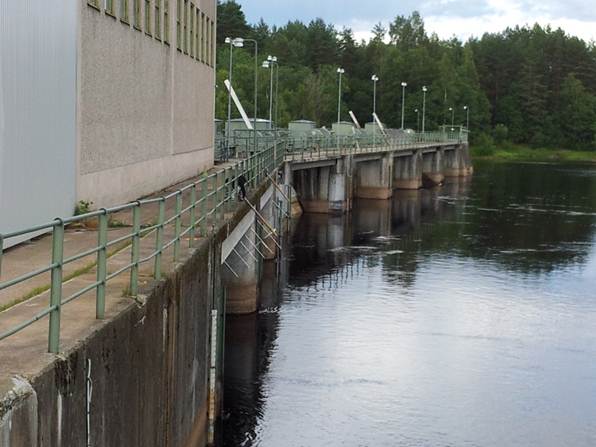
Edsforsens kraftverk med turbin-intaget i förgrunden och spill-luckor längre bak i bild. På fotot syns också antenner vi använde för att studera beteende avradiomärkta kelt i relation till dammen och kraftverket.

Läs mer om laxen i Klarälven i rapporten “Vänerlaxens fria gång”.

World Fish Migration Day 2016

Posted by Daniel Nyqvist | Nyheter

World Fish Migration Day will be organized on a multitude of locations around the globe on the 21st of May 2016. The organizers at World Fish Migration Platform encourage local events and activities. In an e-mail sent out to potentially interested persons, groups and organizations they write:

worldfishmigrationday

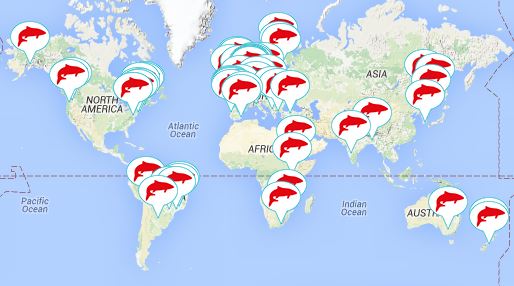
At worldfishmigrationday.com one can see already registered events on a world map.

“On behalf of the World Fish Migration Platform, you are invited to join the 2nd World Fish Migration Day, to be held on the 21st of May 2016. 

With WFMD2016 the WFMP hope to achieve a big impact on fish migration policies, measures and management, from local to global. Local events can be: celebration on a dam/weir removal, inauguration of a fishway or a river restoration project, special trainings/workshops, research activities in the field, special school programs and involving students/citizens, etc. Come join in the celebrations by organizing an event with your organization on World Fish Migration Day 2016…

…If you would like to host an event, you can register your event directly on our website worldfishmigrationday.com. If you have any questions or would like to know more, please don’t hesitate to contact Kerry Brink.”

John Piccolo, researcher at NRRV and Karlstad University, has recently published a letter in Ecology of Freshwater Fish titled: “The Land Ethic and conservation of native salmonids”. In the letter he uses salmon conservation as a case study and goes on to write about an ongoing discussion about why we should conserve species, ecosystems and nature in general. The letter concludes:

“Time is running out. The next generation of conservation biologists will likely preside over a time when the future of much of the  remaining diversity of life on Earth will be decided. I believe that conservation biologists must seek for themselves the answer to he question ‘Why do we conserve nature?’ Those that find themselves convinced, as others have done, that nature is good in and of itself ought to waste no time in expressing for others our duty to do what is right. Conservation biologists should lead the way in eaching that we ought to conserve nature not only because it is good for us, but simply because it is good.”

Read the letter here.

Laxvandring i Dalälven

Posted by Daniel Nyqvist | Nyheter

Anna Hagelin, tjänstledig doktorand på Kau, jobbar just nu med fiskvandring och laxrestaurering i Dalälven.

radiomärkt lax

Anna Hagelin poserar med en radiomärkt lax. Fotot är taget underen studie i Klarälven 2013.

Gefle Dagblad skriver bland annat: “Dalälven är en av Sveriges största reglerade älvar. Utbyggnaden av elkraften har gjort att det inte längre finns någon självreproducerande lax och havsöring i den nedre delen av älven. Havsvandrande fisk kan inte ta sig upp. Den lax och havsöring som i dag finns i älven har satts ut på konstgjord väg. 

Nu finns planer på att skapa en miljö i älven som gör det möjligt att återfå fiskvandring från havet och bygga upp ett självreproducerande bestånd av lax- och havsöring i älvsystemet från Älvkarleby upp till Näs. Ett tvåårigt projekt med Länsstyrelsen Gävleborg i ledningen har startats för att ta fram förslag på lämpliga åtgärder.”

I artikeln berättar Anna att “arbetet kommer bland annat att handla om att lokalisera potentiella lek- och uppväxtområden, sammanställa åtgärdsbehov för dessa samt utreda behov och placering av fiskvägar förbi kraftverk och regleringsdammar”. 

Läs hela tidningsartikeln här.

On December 9 at 16:00 (CET), the World Fish Migration Platform will organize a webinar titled “Fish migrations, dams and food security in the Mekong”.  Eric Baran will present an overview of the Mekong, fish migrations and development perspectives.  Learn more about the webiner and register here. A recording of the presentation will also be available online at the World Fish Migration Plattform.

webinarm

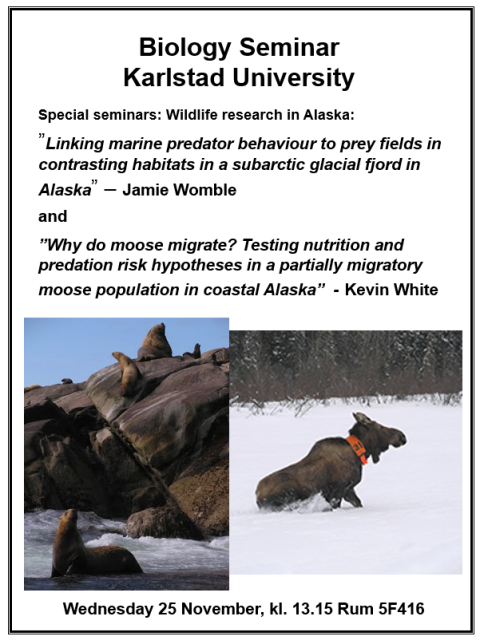
På onsdag, den 25:e November, klockan 13:15 kommer ett seminarium med temat “Wildlife research in Alaska” att organiseras vid Karlstads universitet. Två föreläsningar kommer att ges: ”Linking marine predator behaviour to prey fields in contrasting habitats in a subarctic glacial fjord in Alaska” av Jamie Womble och ”Why do moose migrate? Testing nutrition and predation risk hypotheses in a partially migratory moose population in coastal Alaska” av Kevin White.

alaska

Seminariet ges i sal 5F416 på Karlstads universitet. Alla är välkomna!

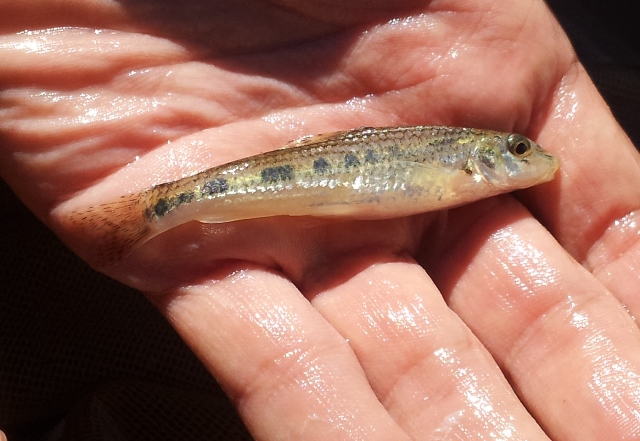
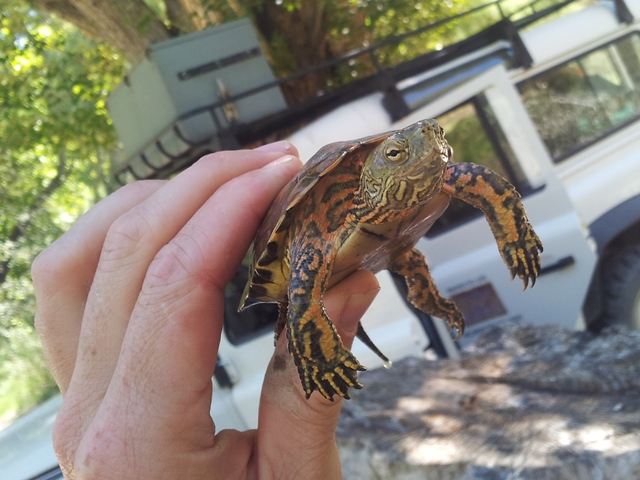
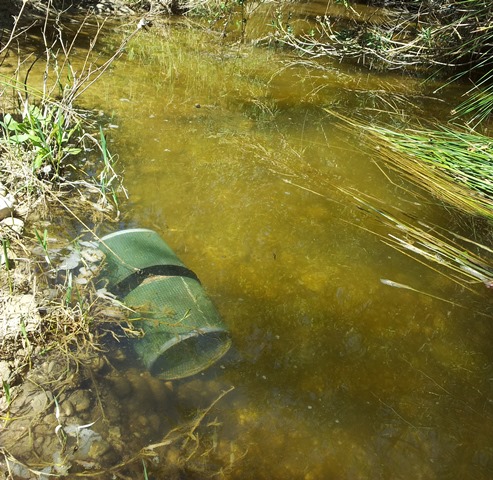
Earlier in the autumn I visited the fish passage project ”Segura Riverlink” in the Segura River, Spain. While in Murcia I also visited researchers at Universidad de Murcia who are involved in studying effects of the newly constructed fishways on the local fishes. I joined Francisco Oliva Paterna, Ana Sanchez Perez and Juan Franco Galera to sample fish in areas affected by the migration obstacles and the new fishways, both in the Segura River and in a tributary. They are sampling fish in affected river stretches before and after the construction of the fishways to study potential changes in species composition and fish distribution. During my visit we sampled fish using electrofishing and minnow traps. The Andalusian barbel (Luciobarbus sclateri) is the star of the Segura Riverlink project and was caught in high numbers. Exotic species are abundant in the Segura River. By electrofishing, we sampled plenty of Iberian gudgeon (Gobio lozanoi) and Iberian nase (Pseudochondrostoma polylepis), both species native to Spain but most likely introduced by humans to the Segura River basin. Other exotic species caught were pumpkinseed (Lepomis gibbosus), northern pike (Esox lucio), common bleak (Alburnus alburnus) and common carp (Cyprinus carpio). The minnow traps were used in the smaller tributary. Here we caught principally Iberian gudgeon and Andalusian barbel but also a couple of Mediterranean turtles (Mauremys leprosa). It was an interesting and pleasant visit. I wish the group good luck in their future work and hope to return.

barbo_,marcaje

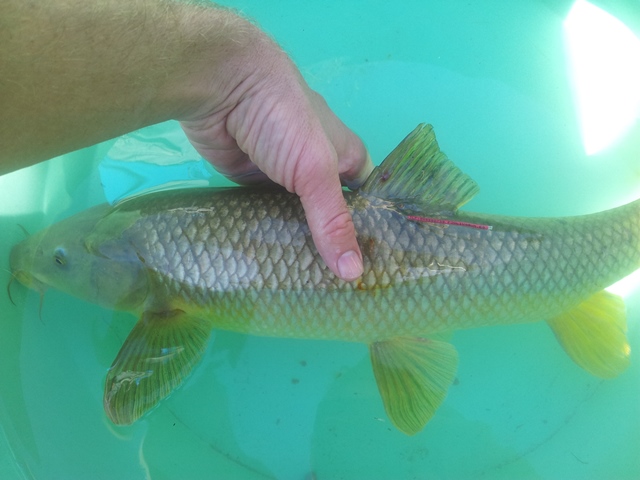
An Andalusian barbel tagged with an external mechanical tag with a unique ID-number. Future recaptures of this individual fish will result in information of its movement and growth.

seg_cypx

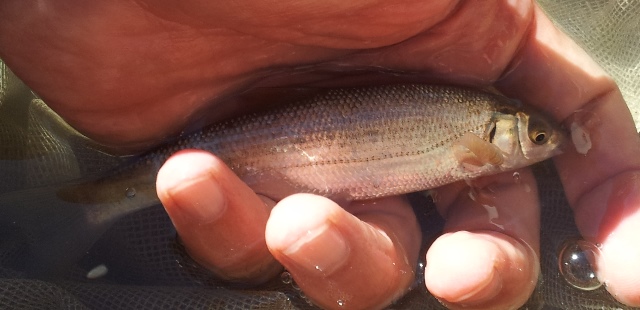
Iberian nase (Pseudochondrostoma polylepis).

seg_goby

Iberian gudgeon (Gobio lozanoi)

seg_tort

Mediterranean turtle (Mauremys leprosa).

cage

A minnow trap in the tributary.

John Piccolo writes about the ongoing Masters course Ecological Resource Management at Karlstad University:

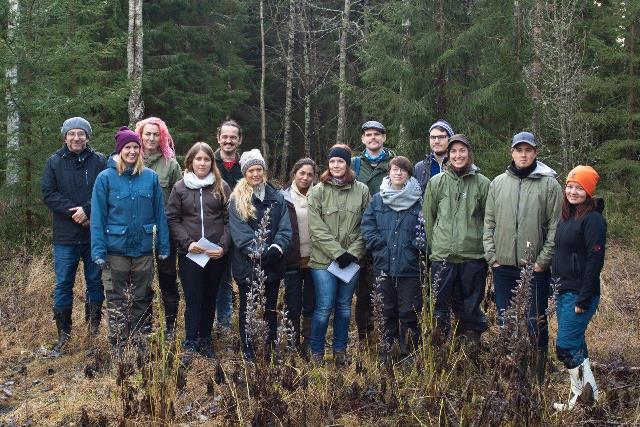
“Our Masters course on Ecological Resource Management is now underway for fall 2015.  Students can read the course on campus or by distance, and we have a field and lab study week in the beginning of November. This year we discussed watershed management and invasive species in the historic Alsterdalen, home of reknowned poet Gustaf Fröding. Professor Lutz Eckstein led the discussion on invasive plants (such as late-blooming Lupine, see group foto). Then we drove over the divide to Klarälvsdalen and downriver to the Almar Forest (Almar skogen). There we discussed forest management with Ove Nystrand, forester for Svenska Kyrkan. 

On the second day we traveled down the River Gullspångsäven, home of the world-reknowned landlocked salmon, Gullspångslaxen. We met Robert Skogh, Mariestads kommun, and got a great overview of his efforts over the past 20 years to protect Gullspångslaxen. Then it was back up to the River Klarälven, where Johnny Norrgård and Olle Calles led the discussion on migration and conservation of Klarälvslaxen (Klarälven salmon).  In the course we use Lake Vänern salmon and trout as a case study for resource management. The students follow up with their own case studies, which will include diverse topics such as Lynx, Lupine, woodpeckers and windpower/bat interactions. It is an exciting course and educational for the teachers and well as the students. “

resman_group

John Piccolo (far left) and students at the Masters course “Ecological Resource Management”.

resman_

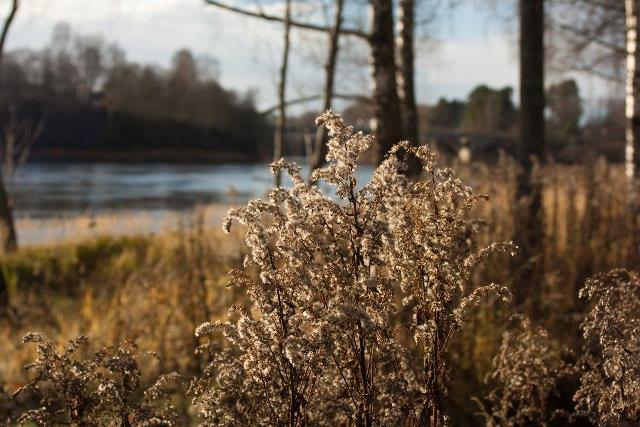
Invasive Canadian goldenrod (Solidago canadensis) by the River Klarälven.

resman_forest

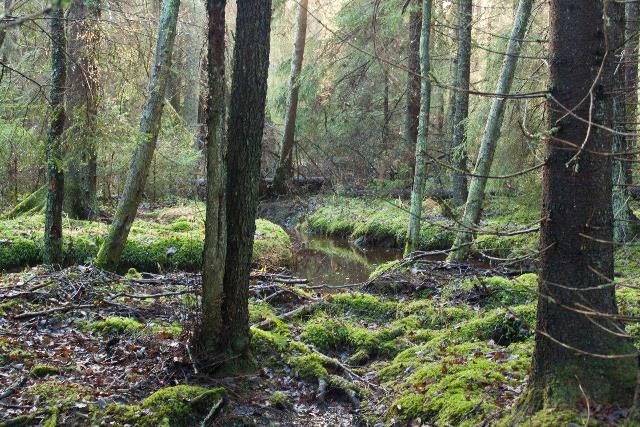
Small stream in the Almar forest.