Book: Biology and Ecology of Pike

Posted by Karl Filipsson | Book

The book Biology and Ecology of Pike, edited by Christian Skov (Technical University of Denmark) and Anders Nilsson (Karlstad and Lund Universities) was recently published by CRC Press. The two editors have also authored several chapters in the book. The book is described to “emphasize the progress of pike research during the past two decades, highlight human dimension aspects in recreational fisheries, and to address environmental circumstances on pike populations including the pike individuals.” Read more about the book here.


Marcell Szabo-Meszaros, Christy Ushanth Navaratnam, Jochen Aberle, Knut Alfredsen (Norwegian University of Science and Technology), Ana T. Silva, Torbjørn Forseth (Norwegian Institute for Nature Research), Olle Calles (Karlstad University) and Hans-Petter Fjeldstad (SINTEF Energy Research) recently published the scientific paper “Experimental hydraulics on fish-friendly trash-racks: an ecological approach” in the journal Ecological Engineering. The study is part of the project SafePass, where methods for safe and efficient migration for salmonids and European eel past hydropower structures are evaluated. SafePass aims to facilitate fish migration in regulated rivers, using perspectives of both the fish and the hydropower industry. Read more about SafePass here.

In the abstract of the paper, the authors write: ”The obstruction of fish migratory routes by hydroelectric facilities is worldwide one of the major threats to freshwater fishes. During downstream migration, fish may be injured or killed on the trash-racks or in the hydropower turbines. Fish-friendly trash-racks that combine both ecological and technical requirements are a solution to mitigate fish mortality at a low operational cost. This study presents results from an experimental investigation of head-losses and the hydrodynamic performance of six angled trash-rack types with 15 mm bar spacing, varying bar-setup (vertical-streamwise, vertical-angled and horizontal bars) and bar profiles (rectangular and drop shape) under steady flow conditions. The trash-racks were positioned at 30° to the wall of the flume and combined with a bypass at their downstream end. The impact of the different trash-rack types on the upstream flow field was characterized using Image based Volumetric 3-component Velocimetry (V3V) and at the bypass-entrance using an Acoustic Doppler Velocimeter (ADV). The results show that trash-racks with vertical streamwise and horizontal oriented bars with drop-shape profiles have similar head-losses (13% difference), while trash-racks with vertical-angled bars provide 3–8 times larger head-losses compared to the remaining configurations. The velocity measurements showed that the highest flow velocities occurred for configurations with vertical-angled bars (0.67ms−1 and 0.81ms−1 on average, respectively).Turbulence related parameters (e.g. Reynolds shear stresses and Turbulent kinetic energy) were also investigated to evaluate the performance of the alternative trash-racks from both, engineering and ecological perspectives.”

Access the paper here, or e-mail any of the authors.

The Volumetric 3-component Velocimetry (V3V) system used in the study.

For the first Tuesday seminar of the year, Kristine Lund Bjørnås, PhD-student at Karlstad University, will talk about evidence synthesis in environmental science. The seminar will be held Tuesday 23 January at 13:15 in room 5F416 at Karlstad University. Everyone is welcome to attend the seminar.

In preparation for the seminar, Kristine writes:

“In these times of alternative facts and post truth, the role and authority of scientists in society is challenged. It is therefore important that we as scientists continue to improve our methods and communication – and one way of doing that is to increase interaction with the end-users of scientific findings. In environmental- and natural resource management, many important policy and practice decisions are not being taken based on the best available scientific evidence, even when that is an explicit management objective. For instance, in a questionnaire among conservation practitioners in England, the majority (77%) reported that they used “commonsense”, “personal experience” or “speaking to other managers” as their primary source of information prior to management actions (Sutherland et al. 2004). This might be because there is no clear understanding of what the best available scientific evidence (i.e. “what works”) is. As a response to this need for more evidence-based environmental management, systematic reviews have found their way also into environmental science.

Brown trout (Salmo trutta), the model species of Kristine’s dissertation project, in an aquarium at Karlstad University.

In this seminar I will go through the principles of systematic reviewing literature, the strengths and weaknesses of the method, and I will talk about my current review project.”

References:

Sutherland, W.J.; Pullin, A.; Dolman, P.M. & Knight, T.M. 2004. The need for evidence-based conservation. TRENDS Ecol Evol. 19.6.

See also:

Mistra Council for Evidence-based Environmental management

Collaboration for Environmental Evidence

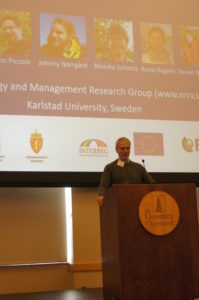
Larry Greenberg at the Lake Champlain research conference.

The Lake Champlain research conference Lake Champlain: Our future is now was held at the Davis Center, University of Vermont, in Burlington 8-9 January 2018. The conference covered a variety of topics, including climate change and native fish restoration. Larry Greenberg, professor at Karlstad University, was invited as keynote speaker at the conference and gave the talk “Conservation of landlocked Atlantic salmon in a regulated river: Taking a holistic approach.” Read more about the conference here.

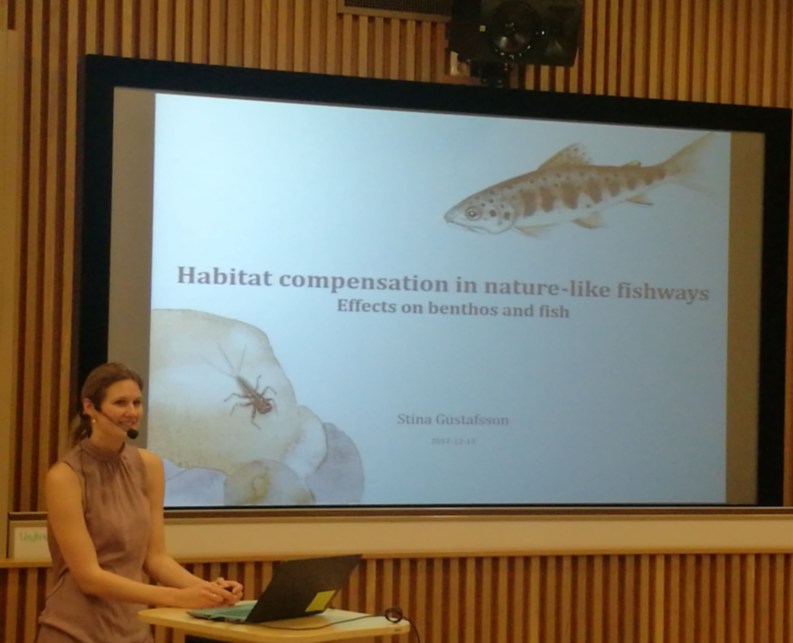
Stina Gustafsson presenting her thesis.

Last Friday, Stina Gustafsson successfully defended her PhD-thesis Habitat compensation in nature-like fishways – effects on benthos and fish”. Paul Giller (Cork University, Ireland) was the opponent, and Frauke Ecke (SLU, Sweden), Brendan McKie (SLU, Sweden) and Jouni Taskinen (University of Juväskylä, Finland) constituted the grading committee.

Stina Gustafssons supervisors during her PhD were Martin Österling and Olle Calles.

The thesis is available online here. Contact Stina Gustafsson for questions and additional information.


On Friday, 15 December, from 13:00, Stina Gustafsson will defend her PhD-thesis “Habitat compensation in nature-like fishways – effects on benthos and fish”. Paul Giller (Cork University, Ireland) will be the opponent, and Frauke Ecke (SLU, Sweden), Brendan McKie (SLU, Sweden) and Jouni Taskinen (University of Juväskylä, Finland) constitute the grading committee. The defense will take place in 1B306 (Fryxellsalen) at Karlstad University. Everyone is welcome to attend!

In the abstract to the thesis, Stina Gustafsson writes: “The construction of nature-like fishways has become an increasingly common measure to restore longitudinal connectivity in streams and rivers affected by hydroelectric development. These fishways also have the potential to function as habitat compensation measures when running waters have been degraded or lost. The habitat potential has however often been overlooked, and therefore the aim of this thesis was to examine the potential of nature-like fishways for habitat compensation, with special focus on the effect of added habitat heterogeneity. 

This thesis examines the effects of habitat diversity on the macroinvertebrate family composition and functional organization in a nature-like, biocanal-type fishway. The biocanal contained four habitat types; riffle, pool, braided channel and floodplain. The effects of habitat diversity and large woody debris on brown trout habitat choice was also investigated in the biocanal. In addition, and prior to introduction of the threatened freshwater pearl mussel into the biocanal, the suitability of different brown trout strains as hosts for the mussel was examined. 

The results show that the habitat heterogeneity in the biocanal contributed to an increased macroinvertebrate family diversity. The functional organization of the macroinvertebrate community suggests that it was a heterotrophic system and more functionally similar to the main river than to the small streams that it was created to resemble. Brown trout habitat choice studies showed that high densities of large woody debris increase the probability of fish remaining at the site of release. Testing of different brown trout strains as host for the freshwater pearl mussel revealed that both wild and hatchery-reared brown trout strains were suitable hosts. In summary, the results indicate that it is possible to create a fish passage with added value through its high habitat function and that nature-like fishways can be designed to reach multiple species restoration goals.”

The thesis is available online here.

On Thursday, 14 December 14:00, Brendan McKie, one of the members of the grading committee, will give a presentation titled:  “River restoration and biodiversity and ecosystem functioning in tributaries of the Vindel River: The importance of restoration intensity and time”. The seminar will be given in room 5F416, at Karlstad University. Everyone is welcome to attend also the seminar.

Johan Watz, Anders Nilsson and Olle Calles from Karlstads Universitet, and Jonas Elghagen from Elghagen FIskevård, recently published the scientific note “Evaluation of a novel mobile floating trap for collecting migrating juvenile eels, Anguilla anguilla, in rivers” in the journal Fisheries Management and Ecology.

In the abstract, the authors write: “To improve the situation for the threatened European eel in regulated rivers, better methods need to be developed that more efficiently collect and transport juvenile eels past dams. In this study, a novel mobile, floating eel trap is described, and the results from an evaluation of the trap in two Swedish regulated rivers are presented. The mobile trap was designed to reduce the length of the climbing distance while maximizing the width of the entrance. The mobile trap caught more juvenile eels than a stationary eel ladder, serving as control. Furthermore, the mobility of the floating trap enables adaptive placement and thus offers managers the possibility to search for the spatial optimum for trapping efficiency.” Access the paper here, or e-mail any of the authors. 

The mobile floating trap next to the stationary eel ladder used as control. Photo from the Watz et al. 2017.

The mobile floating trap without cover. Juvenile eels climb the short and wide ramps (black) and slide (on the small metallic shutes) towards the left (in the photo) were they are collected. Photo: from the papers supplementary material.

The trap in the tailrace of a hydropower plant in River Lagan.

A sample of juvenile eels caught in the study, here held in a 10 L bucket.

Dennis Lafage relatively recently started a postdoc within the NRRV-research group at Karlstad University. Here he briefly presents his background and what he plans to do during his postdoc:

“My name is Denis Lafage. I recently started a post-doc in the NRRV group to work on aquatic/terrestrial exchanges. I started research after working 10 years in Nature Reserves and Conservation Agencies where I was specialized in terrestrial fauna monitoring and conservation (mainly birds, invertebrates, and bats), statistics, GIS and database management.

I completed my doctorate in 2014 from the Muséum National d’Histoire Naturelle de Paris (France). My PhD thesis was dealing with the impact of management practices and natural perturbations (mainly flooding) on arthropods (spiders and carabid beetles) and plants in meadows. It also included a study using remote sensing technics to map vegetation associations using satellite imagery.

I consider myself as a community ecologist with a particular focus on arthropods. In the NRRV group, I will particularly work on a meta-analysis on the landscape drivers of aquatic/terrestrial fluxes. I will mainly focus on studies using stable isotopes for diet partitioning. As I have a particular interest in what we could call ‘perturbation ecology’ I will also work on food webs after spring floods. I have also the chance to be the co-advisor of a PhD based in Norway aiming at forecasting the impact of climate change on fishing spiders repartition in Scandinavia. Finally, I will also be involved in various projects where my skills in terrestrial arthropod ecology are required.”

Read more about Denis Lafage on his blog denislafage.wordpress.com.

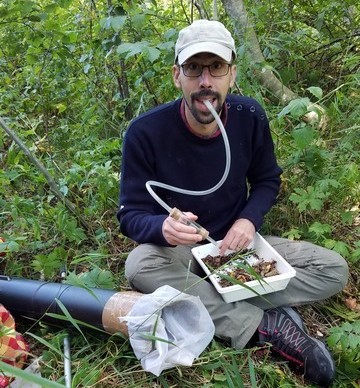
Denis Lafage, sampling spiders in Sweden.

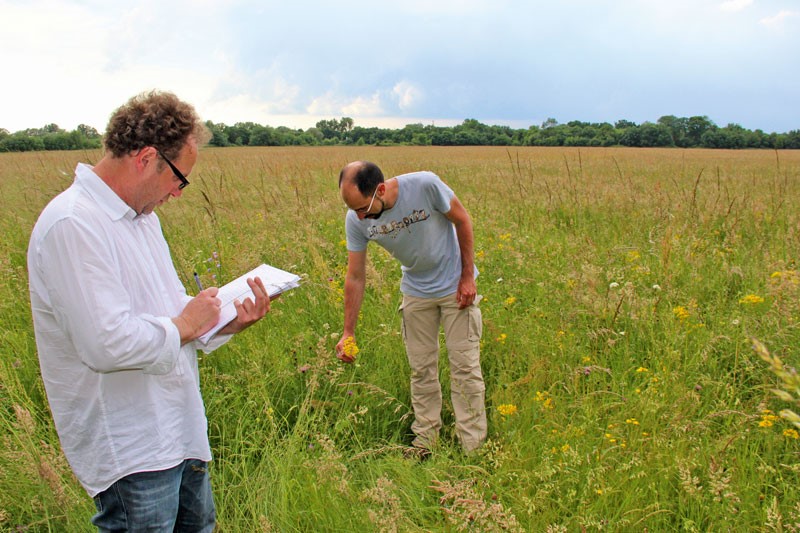
Denis Lafage, in back, and a collegue, sampling vegetation in Nantes, France.

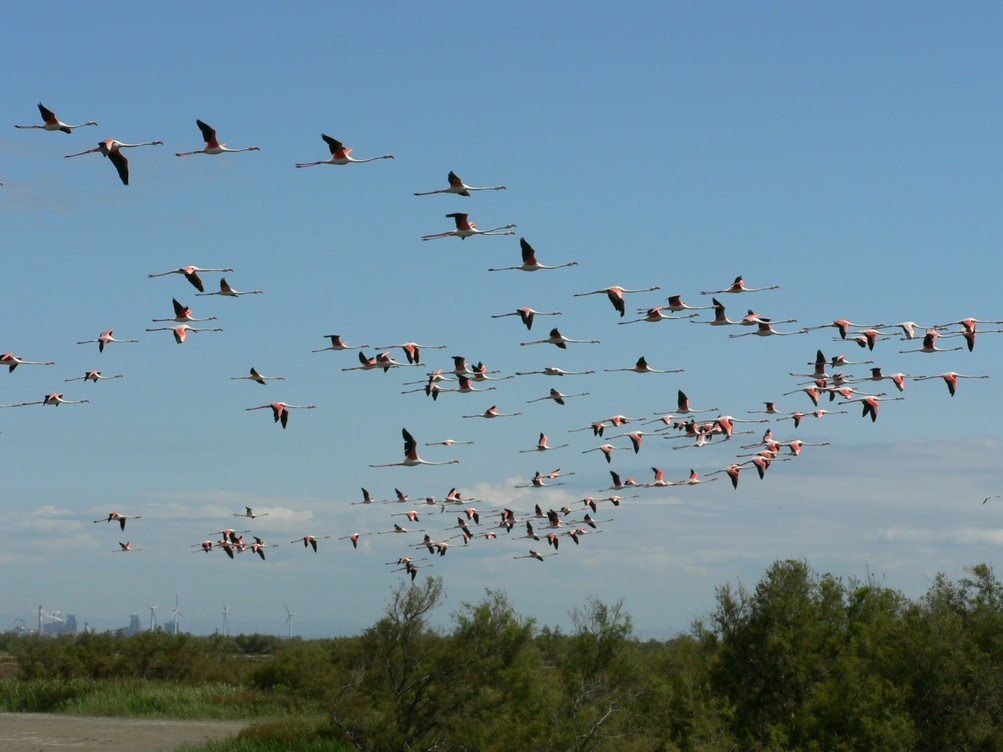
In Denis Lafage precious work, he has been counting birds (Flamingo) in Caramargue, France.

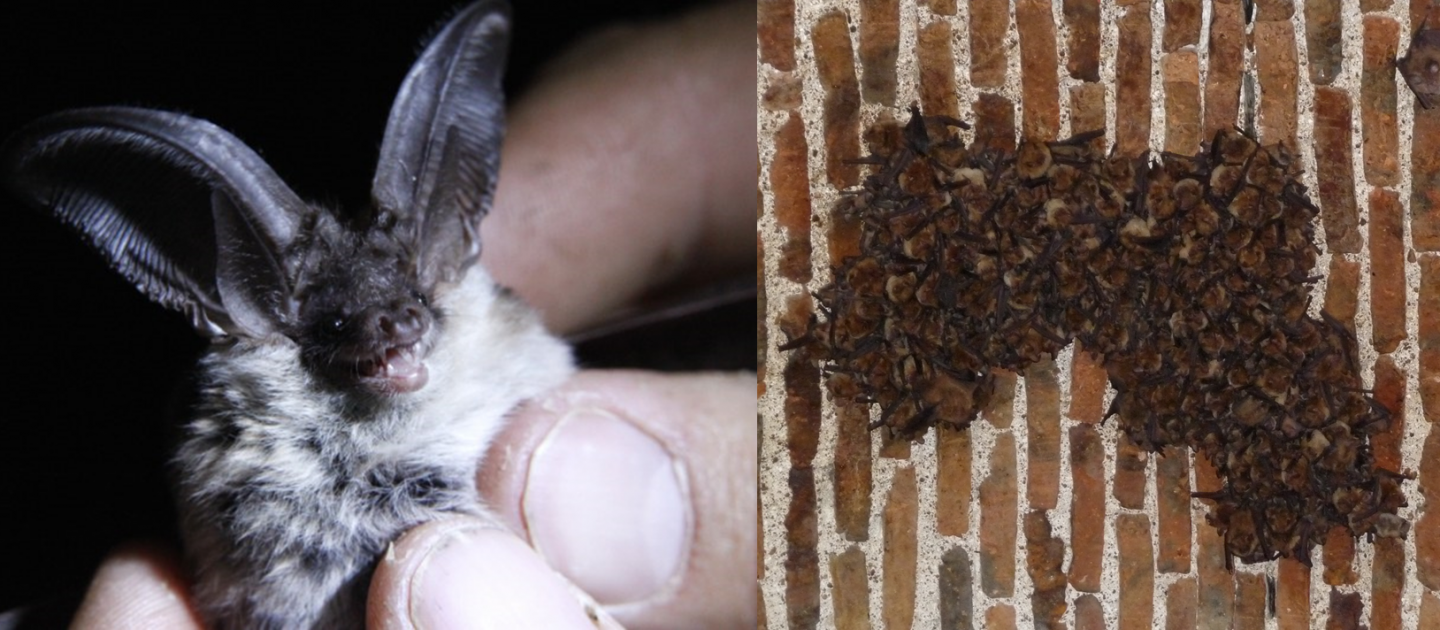
And capturing and counting bats in roosts (France).

Film: Många bäckar små

Posted by Daniel Nyqvist | Dam removal

Sportfiskarna presenterar tillsammans med Freewater Pictures filmen “Många bäckar små”, om det rinnande vattnets naturvärden och dammutrivningsprojekt i Hudiksvalls och Nordanstigs kommuner. Se filmen här:

YouTube Preview Image

Jessica Dolk märker i filmen öring med radiosändare. Det är en del av NRRVs studier på vandrande fisks beteende i Nianån, efter dammutrivning. Läs mer om dessa studier här. Undersökningen av fiskvandring i Nianån är en del av en större studie på ekologiska effekter av dammutrivning i området. 

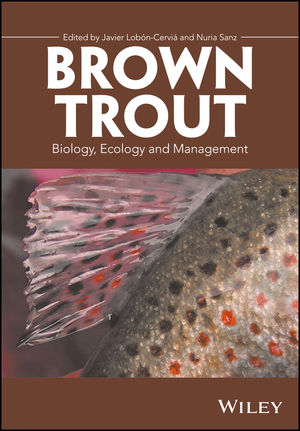
The book, “Brown Trout: Biology, Ecology and Management”, edit by Javier Lobón-Cerviá and Nuria Sanz was recently published. The book is described as “a comprehensive guide to the most current research, history, genetics and ecology of the brown trout including challenging environmental problems”. John Piccolo and Johan Watz, both researchers at Karlstad University, have written the chapter Foraging Behaviour of Brown Trout: A Model Species For Linking Individual Ecology to Population Dynamics? They summarize their chapter as follows:

“Within the discipline of stream fish ecology, population-, community-, and even ecosystem-level patterns and processes have assumed an increasingly larger role in recent decades. It might be argued, however, that research on the behaviour of individual organisms ought still to play a major role in ecology; it is upon the individual, after all, that natural selection acts. Thus, one might reasonably expect that observing an individual fish’s behaviour should lead to robust conclusions about the fitness costs and benefits that animals must trade-off in order to achieve reproductive success. And ultimately, it is those individuals that achieve the greatest direct fitness that ought to, on average, drive the population-level processes that have attracted so much of stream fish ecologists’ attention in recent years. In linking behavioral- to population-level ecology, we are in luck when it comes to the brown trout – there is no stream fish species whose population ecology is better quantified, nor are there many species that have received more attention from behavioural ecologists. Thus we might consider the brown trout as a model species for developing the ecological understanding of how natural selection (e.g. individual, fitness-based decisions) acts to regulate stream fish populations. To forward this concept, a further development of a quantitative approach to foraging behaviour is warranted. In this chapter we review and synthesize the literature on brown trout foraging experiments with an eye towards identifying the knowledge gaps that remain to be filled in order for ecologists to quantify the fitness costs and benefits of foraging behaviour.”

The book is available (but expensive) here. For access to the specific book chapter, email John Piccolo or Johan Watz.